Join 21K other subscribers

Tag: Nucleus Accumbens

  • Are you Addicted to Casino Slot Machines? Reason.

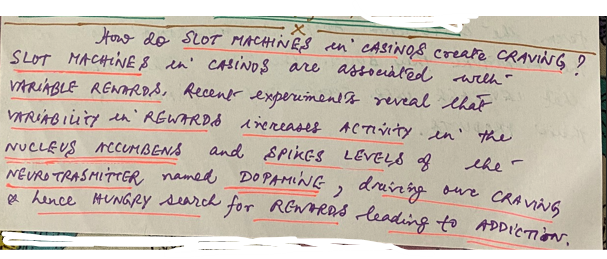
    Are you Addicted to Casino Slot Machines? Reason.

    Are you addicted to casino slot machines? Read this blogpost to know the exact reason.

    Slot machines in casinos bring in Variable Rewards which stimulates the brain’s pleasure center (Nucleus Accumbens), responsible for cravings.

    Read some more insightful posts from the same book here –

    https://viewpointsunplugged.com/?s=hooked

  • Peculiarity of Brain’s Pleasure Center. What?

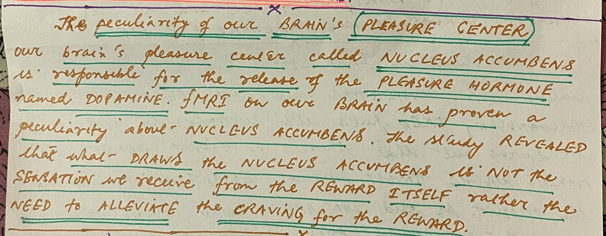
    Peculiarity of Brain’s Pleasure Center. What?

    To understand the peculiarity of the brain’s pleasure center or Nucleus Accumbens, please read this wonderful insight.

    The insight has been inspired from Nir Eyal’s book Hooked.

  • Why extrinsic rewards are a source of depression?

    The Carrot and Stick method of motivation to stimulate desired behavior from individuals focuses on EXTRINSIC rewards to stimulate desired behavior.

    Rewards in such a case act as an addictive agent and activates reward seeking addictive behavior in individuals.The expectation of reward stimulates nucleus accumbens and makes us eager to perform the task in the expectation of rewards.This may even come at the cost of unethical behavior , narrow short term focus and other malpractices.

    But these rewards are in no means a source of fulfillment since the enjoyment is short lived and makes us long more such rewards.When the rewards are not received it leads to depression and flow of cortisol.

    Thus the way forward is intrinsic motivation driven motivation system that focuses on fulfillment as opposed to addictive rewards.

    Adopted from Daniel Pink’s book Drive

  • Understanding the science behind reward cues in casinos

    Casinos surround themselves with reward cues for e.g. inexpensive food , free liquor , surprise gifts , potential jackpot prizes etc. to act as reward cues in order to stimulate the Nucleus Accumbens in the human brain.

    The Dopamine or Addictive chemical that flows as a result stimulates risk seeking behavior in human beings to divert them from their risk averse nature.

    Adopted from Daniel Pink’s book Drive

  • The truth fMRI reveals about rewards

    fMRI or Functional Magnetic Resonance Imaging reveals activation of Nucleus Accumbens and the flow of the “Addictive” chemical named “Dopamine” when extrinsic rewards are provided.

    The results are similar to addictive behavior produced as a result of consuming cocaine , alcohol or gambling.

    The downside of “rewards” due to addiction reveals an alarming truth that rewards can lead to both “risky choice” and “risk seeking mistakes”.

    The addictive feeling due to dopamine delights then dissipates and then demands another dose.This is never a long lasting feeling of fulfillment.

    Adopted from Daniel Pink’s book Drive

  • Expectations and their relationship with “Dopamine”

    David Rock in his book “Your Brain At Work” talks at length about the relationship of human expectations & their interrelationships with the limbic brain.

    “Dopamine” is a neurotransmitter which is conjunction with nucleus accumbens plays a major role in reward and motivational behavior in humans.

    Amygdala is the region of the brain responsible for the release of this hormone “dopamine” which plays a very key role in motivational behavior out of risk/reward situations.

    Limbic brain follows a “toward” approach for good emotions when the expectations are met and “away” approach when whatever is expected is not achieved.

    When our expectations are met , the “dopamine” flow results in motivational behavior helping us achieve good results.

    Unexpected rewards can cause much higher level of “dopamine” flow and hence can help us achieve much beyond our potential at times.

    Worst effect happens when we imagine and expect rewards out of a situation but the actual results are far away from our set expectations and targets.This is what results in huge level of stress and downgraded performance.

    Hence the best way out to avoid such kind of stressful situations is to lower our expectations to ensure that come what may the results would match our expectations.